The Hues of These New Colors - What Lessons in Love Means to Me
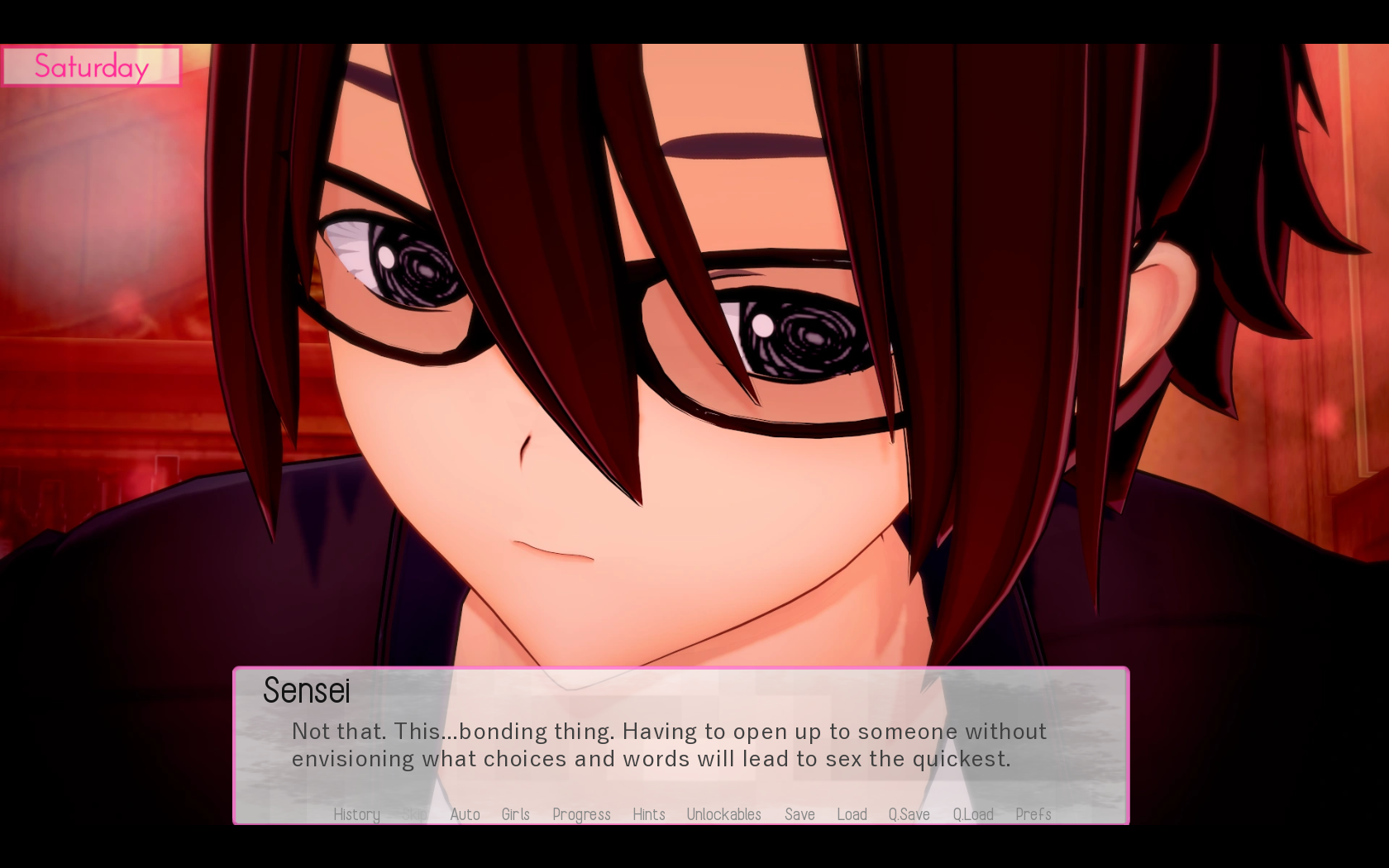
Lessons in Love is an ongoing visual novel about a teacher who's a sex predator grooming his class of twenty students. While this article will bring up abuse, grooming, sexual trauma, self-harm, and mental health issues, the game also has intense flashing lights, spider imagery, and brings up eating and other related disorders.
As for spoilers, I've played up to .58 (the latest patch as of this writing). I'll be writing broadly, though the article excerpts events throughout the four existing chapters.
I am primarily writing for two audience groups: people who aren't playing the game or fans who are hungry to read any material about it. Anyone who intends to play the game or is playing it right now is welcome, but it may be better to wait until you've caught up.
While staying up late and drafting the final paragraphs of the article -- some of the best in my view -- a relative who was already known by my family to be gravely ill passed away in the hospital. The timing was uncanny. I was deeply affected because I remembered visiting him and thinking about how much pain he was in and his desire to go back home. I don't believe he can read English, but as far as I can understand, he does enjoy watching pornography featuring young women on his phone ... so surely, he'd enjoy some sad Koikatsu grooming media. I don't know him well, but I believe everyone should be remembered for something.
And so, I dedicate this article to him. I hope the women are beautiful up there as they are down here.
In a Chapter 4 event titled "Connect the Dots", Sensei, the protagonist, invites Wakana Watabe, a fellow depressed teacher enamored with Romanticist poetry, into his apartment. He wants her to watch a movie with him in silence to "breathe some sort of normalcy back into this place". When she lightly pushes back on it and asks why he's in the gutters, he admits that "it's hard telling someone a story where there are a million details you need to omit and the ones left over makes everything sound way too simple."
Wakana then points out that he's a writer and he'll figure it out, to which he responds:
Sensei: See...that's the thing, though. I can't.
Sensei: And that's just one more reason I chose poetry as my field of expertise since you don't always need to tell a full story with that. You can normally just throw out a bunch of dots and have people connect them for you.
I found this exchange fascinating. Here was a clue, 110-140 hours in, to read Lessons in Love as a kind of poem, a puzzle for one to wrap their head around. The absurdity wasn't lost on me when most readers who stuck out this long would've already been invested in his convoluted backstory, his sometimes-abusive-and-sometimes-wholesome relationships with his students, his rambunctious banter with his fellow teachers at the Dive Bar, the will-they-or-won't-they romance between him and his childhood friend, the pandemic echoes from living entire lives inside a walled-off city, the elaborate worldbuilding involving diegetic metafiction and apocryphal Christian motifs, the multitude of disparate narrative voices, the dread of sex, the terror of trauma, the nightmare of unrequited love, questions of justice and forgiveness, the constant interrogating of masculinity and gender norms in general, and the tribulations of addiction and recovery. Surely, the people who couldn't stomach any of that would've tapped out earlier.
But this is a rare moment of vulnerability for Sensei. After watching his loved ones get harmed by his actions and inaction, he can't pretend to be the aloof groomer protagonist of an English-language erotic game anymore. He is not in control of himself. As he says later in the scene, "Writing is suffering. How am I supposed to do that when all it does is remind me of what I've lost?" This private admission goes against the common sense of the world we live in, where we equate artistic expression with getting in touch with your feelings; he explicitly states that this is an almost impossible task for people who are trapped in the cycles of abuse and harm. All Wakana (and the readers) can do is connect the dots and hope he will open up someday.
But that's going to be difficult because he doesn't believe he can connect the dots by himself. If he invites his incestuous niece Ami over to hang out early on, she'll reminisce about spending her childhood time with her beloved uncle. Unfortunately, Sensei is incapable of remembering it. Believing he has been reincarnated into the body of a once competent teacher and choosing instead to take advantage of "his" students, Sensei views her precious memories as "anecdotes or poems" that he wish he could peer into. But as he confesses:
One thing that means the world to one person might make absolutely no sense to someone else.
I'm caught in between.
I absorb the things she tells me, racking my brain and trying to connect any dots that someone else may have left behind.
But I came up with nothing.
He is clearly hung up over the premise that "her relationship with me is much more than mine will ever be with her". The sex predator we're supposed to be playing envies the mere possibility of deep relationships that don't involve sex.
Unfortunately for him, Lessons in Love is an adult dating sim.
The first thing that might catch your eye on the game's Itch storefront page is a URL to a Ko-Fi account where fans of the game can donate in order to support charities dedicated to survivors of sexual abuse. Selebus, the author, says he'll match the first $500 in support every month because:
I write about topics that are very close to my heart and the amount of people I've been able to impact in positive ways these last few years has been nothing short of eye-opening.
This mission statement of sorts intrigued me. I knew from people like Quof that the game was doing something different and I would always be partial to any work inspired by Subarashiki Hibi (Wonderful Everyday) and Cross+Channel anyway, but this page stoked my imagination more. The English, Chinese, and Japanese visual novels I've read over the years may broach big ideas about the world, but most are ideologically conservative or at least a status quo defender. And despite the potential subversiveness of adult scenes, these visual novels don't explore for example discourses on queerness and sexual abuse. I thus found it refreshing to see an author feel the need to use their platform to connect fans to these charities.
That said, there is an obvious tension between the game's social justice goals and erotic fiction as its chosen medium: can titillation really coincide with a desire to open discussions about sexuality and trauma? I once tried to explain the game's approach to an acquaintance, and they reasonably read my description as the title having its cake and eating it; it would be much better if it was just a full-on grooming fantasy or a work that takes the subject matter without the eroge-isms. When works blur literary and pornographic aims -- especially when we're referring to a real, malicious social phenomena -- it does make sense for people to simply object to the game, even if they are familiar with extreme content.
Still, I find the way the game navigates these waters fascinating. It seems aware of its strange stance, but it pushes onwards anyway. I feel like learning how to interpret these tensions is part of the reading process. If I simply read this game at face value, I wouldn't lose so much sleep over finding the precise vocabulary that circumscribed the domains and limits of what the game's going for -- but I suspect that I would miss out on what makes the writing so unique and memorable. It is this paradox that revives me in the dead of night: "How can a game like this exist? It must fail at some point, right?"
My critical sensibilities want to say yes, but my secular faith believes it won't. I identify too well with its project that I can only pray for its success. For the first time in years, I feel a sense of belonging to a work of fiction.
The reader is plunged into the city of Kumon-mi (read that in the voice of an American tourist lost in Tokyo): every day, they can guide Sensei to locations around the city to creep on his students and raise affection and lust levels, but sooner than later he finds himself unequipped to handle situations like a student cutting herself or another undergoing a panic attack triggered by sudden loud sounds.
And sometimes, without any player intervention, he will elect to stroll outside the school in the middle of the night as one tends to do:
My feet move on their own and lead me down a path I can not normally see.
I can't say when my body successfully managed to escape the confines of the school, but I am somehow feeling more confined now that I am on the outside.
I can see a place where the sidewalk ends - and a glowing passageway of TV static beckoning me forward.
It's like it's calling me to escape.
It's like it's trying to help me.
And yet-
I can not find it within me to move my legs.
But that's fine, for there are few doors in life that only open once.
And even if this door disappears-
I can tear down whatever wall I want and make a new one.
This place was built for
youme.I can do whatever I want with it.
Everyone else is just furniture.
Everyone else is a part of the pile.
This excerpt belongs to Chapter 1's "Not Even Me". The way the narration interrupts with dashes makes me feel like I need to gasp for air before continuing the trail of thoughts. Sentences are simple, but the specific luminescence of "a glowing passageway of TV static" draws me into whatever world Sensei is heading into. I am also curious about the strikethrough: not only is "This place was built for you me" sentence a motif, but it also builds on the previous line, where the narrator claims the walls of the world can be torn down and rebuilt by them and not whoever "you" is. All this, in spite of the narrator previously admitting that they can't move their legs toward the passageway. Can their resolve really come from knowing that "there are a few doors in life that only open once"? The next lines also raise a few eyebrows: who is this "everyone else" and what does it mean to be "furniture", "a part of the pile"? No matter what the answers to these questions end up being, I see this excerpt as a microcosm of how the visual novel defamiliarizes the language and audiovisuals we use and consume every day.
I also find the prose delightful to read. As I wrote this essay, I found myself reading aloud the excerpts and taking mental notes on the cadence and its readability. It strikes the right balance of being evocative and clear. Like a mystery taking place under cloudless skies, I can clearly see what I cannot see.
And yet, in the same chapter, one will also read "The Bare Minimum", an event featuring the lovable recluse Sana Sakakibara. She helps her mom out in the family bar, but her shyness makes even Sensei worried about her future. Realizing this would make for a great opportunity to hang out with her more, he decides to give her private lessons by pretending to be a rude customer in front of her.
Which leads to this exchange:
Sana: Um...Hello, sir... What can I-
Sensei: Yeah, whatever. Give me a beer and a plate of spaghetti.
Sana: A plate of...spaghetti?...
Sensei: Did I stutter? Or are you really fucking bad at your job?
Sana: Well...I don't think so...but...
Sensei: Listen kid, I'm in a hurry. So if you don't have my spaghetti in five minutes, I'm gonna have to-
Sensei: Wait, Sana, are you crying? We literally just started.
Sana: W...w...we...d...don't...have any...s...sp...spaghetti...
This is even worse than I thought.
Sensei: Sana, if this is too hard-
Sana: I'LLGOGETYOURBEER!!!
Adding insult to injury, Sana brings Sensei a water bottle instead. Even when he gets to the point of the lesson -- that the customer isn't always right -- Sana has difficulty internalizing that she should speak up.
This pointless exercise displaying Sensei's impressively poor teaching skills and Sana's social ineptitude is a far cry from the moodiness of "Not Even Me". Yet, Sana's century of humiliation does have its place in the story: it introduces more concretely the dire state the bar is in if it has to involve a teenager who can't even speak without panicking, and we also see how Sensei changes his act when talking to Sana -- since she is the closest thing to an angel in his eyes, he takes a more assertive teacher role, even if he's utterly incapable of performing pedagogy.
But the character events that stay with me are the ones that reveal a side that I didn't know about. Molly MacCormack is the first standout character for me, though not for the reasons I thought I would have. She appears early in chapter 1 delivering so-called "Weebnotes" that provide some context on otaku media references. Clearly, a character for my heart. But while she moved from Ireland to Japan to be closer to cute anime girls, her real passion revolves around Western fantasy titles. Less the chuunibyou she claims to be and more a sufferer of the Boss Baby syndrome, she likes to connect everything she sees including relationships to World of Warcraft. She is also the game master of an ongoing Dungeons and Dragons 5e campaign -- thanks to her, we get a glimpse into a different, nerdier side of the cast with some surprisingly accurate depictions of tabletop gaming and its frantic sessions.
In many ways, I was surprised by how cognizant she is about the reasons she's interested in subculture media and the fantasy genre in particular. Her chapter 2 event, "Tír na nÓg", best exemplifies this: she broaches the Land of the Young, "a magical land not far off the Isle, where no one can die...and where everyone remains eternally young" in order to talk about her mother who passed away when she was little:
Molly: I don't have many memories of her, to tell you the truth.
Molly: But I do remember a large collection of storybooks and fairytales that she would read to me before she died.
Molly: I wish I remembered more about her specifically...but I think that leaving all of those books behind was just...her way of communicating.
Molly: I wasn't left with nothing like many other children who lose their parents are.
Molly: I still have my father...and mountains of magical myths my mother may have memorized...
Molly: I have pictures of her too. And old clothes I hope to be able to wear one day.
Not only do I find this section poignant but I can also see how Molly values the power of youthful imagination as a way to continue her mother's memory. The fairytales and storybooks of her childhood are now the manga and gacha games she's into.
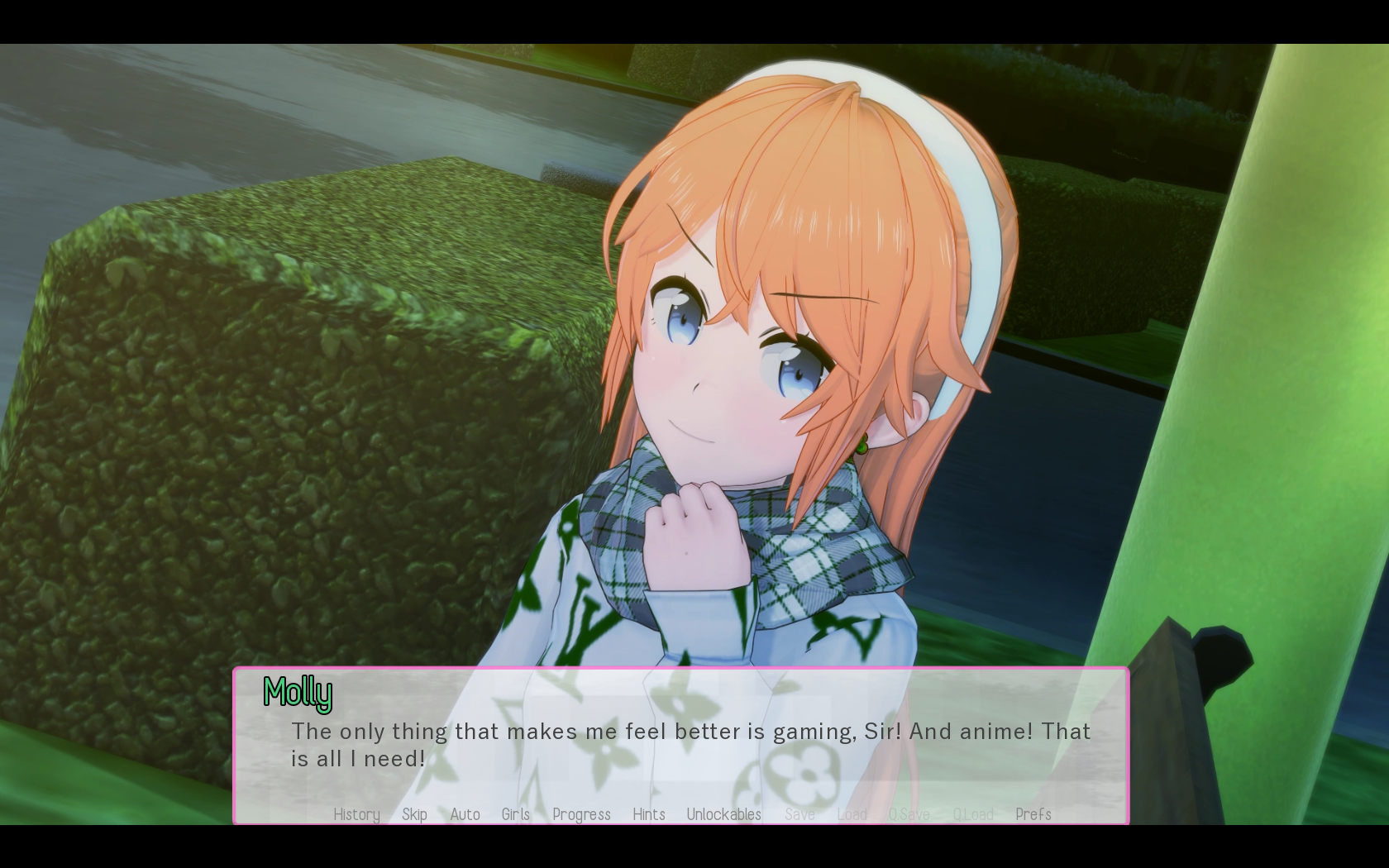
It's a nice, subtle scene that grounds her silly antics in something real, and it made me appreciate early on how noticing minor patterns like this can be as insightful as major plot reveals.
Another character who resonated with me in a more profound way is Yasu Yasui. Before her proper introduction in chapter 2 where she loudly proclaims she has nightvision, her appearances are sprinkled through the first chapter where she mumbles about how much she is channelling her god to speak the truth. It is easy to get lost in the weeds, extracting her mutterings about the universe for one's theorycrafting. But as her based ojousama roommate Touka Tsukioka reminds us, she's actually a teenager who wants to connect with people but sees herself as a "worm" who doesn't know how to communicate.
When she is roped into the Manga Club in Chapter 3's "Sore Thumb", the members try to recommend her all kinds of comics for her to read. However, her religious values forbid her from reading any material with potential pornographic or violent elements. She gravitates instead to slice-of-life manga:
I hand the book over to Yasu, who accepts it with the least creepy smile I have seen out of her thus far.
She opens it up and begins reading very slowly, focusing for far too long on each and every page as if she's taking in every last detail and every last line.
I'm sure that the artists involved would be happy to see this, but even then I think they'd believe it to be a tad excessive.
Molly and Futaba cross the room and take their places beside me like we're some sort of proud, polyamorous couple watching our daughter take her first steps.
I'm just a little disappointed because her steps are in a direction that I'm not particularly interested or invested in.
But hey, this is the first time I've ever seen a smile like that out of her.
And it's a lot more infectious than those that have been induced by her god.
Yasu continues reading until the sun begins to set while the rest of us talk quietly amongst ourselves.
When the final bell rings, Yasu closes her book and thanks all of us for our help.
But not before grabbing three more books of what I expect and hope are the same genre.
I remember feeling moved when I finished reading the scene. While I don't believe I am yet a part of the "proud, polyamorous couple", I do feel kinship over the idea of seeing "our daughter take her first steps."
It's a new wrinkle to her otherwise unvaried life proselytising about her church. She stops adorning her trademark creepy smile and actually enjoys something that isn't relevant to her religion. I also find it adorable that her fixation on the details might even discomfort the artists; she's mustering her usual evangelical energies into an appreciation of the manga form. After plodding through her cumbersome sermons, I found it comforting to imagine her as a girl who could lead a relatively stable life reading slice-of-life manga and having a good time.

But this is a sigh of relief that will be overwhelmed by what is to come. Much later in the chapter, "An Apple A Day" introduces details of Yasu's earlier life through a diegetic flashback, a technique rarely used in the game: her mother is frustrated by the medical establishment claiming for the 12th time that she is schizophrenic; like come on, her ability to predict the future and mimic "the EXACT WAY my dead mother used to speak despite never even meeting her" must mean something. Yet, the doctor explains:
Doctor: Schizophrenia is far more complex than someone who just "hears voices in their head." It's a brain disorder that effectively manipulates every aspect of a person's life from their speech to their behavior.
[...]
Doctor: I understand your concerns with the diagnosis but, unfortunately, there's still a great deal we don't understand about schizophrenia as it has a direct impact on a person's ability to perceive reality.
Doctor: There is no way we can ever see or replicate what Yasu sees as this is all happening in her head.
When the doctor learns that Yasu has been vomiting out her medication, the least they could do is refer her to a clinic offering "antipsychotic injections that may help to alleviate her symptoms". Yasu's mother feels powerless, ranting about how this will be her 13th clinic and maybe she'll reach "twenty by the end of the month".
The doctor continues:
Doctor: I understand that this is hard, but...back to the injection, it is important to note that this is not something we typically recommend for children as there is an elevated risk for serious side effects.
Doctor: The medication will target your daughter's neurotransmitters...serotonin, dopamine, and so forth...and will remain in the bloodstream for several weeks, where it will slowly-
Yasu's Mother: Whatever. Okay. Fine. Added risk makes no difference to me.
There's a bit more afterwards that makes the scene even more heartbreaking, but what we have should be enough to notice how eerily specific the rhythm of this dialog gets.
The doctor is navigating the middle ground between detachment and sympathy -- their ellipses in the second excerpt seem to contain hints of anxiety as they articulate the potential physiological effects on Yasu's body -- but their attempts are rebuffed by Yasu's mother who gains no practical insight into her condition. Her mother insists immediate fixes, unrealistic they may be, to make Yasu her "normal" girl again. Both adults have found themselves trapped in the psychiatric reality where drugs are not the panacea or evils the public imagines them to be. This impasse can only end in a screaming match where nobody wins and Yasu, already dissociating, is dragged to the next clinic.
I'm not only stunned by how the hostile, counterproductive atmosphere oozes out from the rhetorical stalemate between Yasu's mother and the doctor, but also how accurate it is at depicting how patients and their loved ones are let down by medical institutions in very specific ways that aren't widely publicized. The medical status quo refracts the same class inequalities that we can read about in newspapers. I am pissed off by the way Yasu's mother sees her, but I also understand she has sacrificed her life to take care of Yasu. It takes a bit of restraint from me to evaluate how the doctor and Yasu's mother are failing her without judging them too harshly.
Later in Chapter 4, Touka's family decides to adopt Yasu and also take care of her medication. However, she starts to lose her personality the more she takes antipsychotic drugs. Worse, she feels isolated without the voices that have kept her company for so long. In a move that really surprised me, her guardians realize that they need to tell the doctors to lessen her dosage because she's becoming not the girl that they've welcomed into the family. It's an emotionally mature worldview on the relationship between medication and people who use it -- sometimes, numbing all the symptoms with drugs is not a great idea.
This is a perspective I've only read about in nonfiction not slated to be airport bestsellers. Yasu is not dangerous, and there is no good reason to cut her off from what gives her purpose. To see Yasu be allowed to thrive in controlled circumstances, I can feel my heart warm up. I can only say that I'm touched by how the game actually reckons with how real people negotiate what they need and don't need from medication.
It is worth noting that these Yasu events do not come out sequentially like I've laid out. They are spread across the chapters, so you can't really focus on a character or even a continuous mood. You might just walk into a scene that is in total opposition to what you just read.
This unpredictability of what comes next is what makes the visual novel so engaging. Will the next event be skeevy, surreal, melodramatic, comedic, contemplative, tragic, or even romantic? I could be reading the greatest takedown in rap battle history and minutes later anguishing over a traumatic event so consequential that I cannot fathom how much more suffering I must endure in the near future. Each scene has its own endearing qualities, but they also connect to the more macro meaning of the story.
Indeed, as much as I enjoy watching the stars with Maya Makinami, getting my heart strung by any scene with Yumi Yamaguchi and her estranged mother Yuki, admiring the ensemble cast in well-composed shots that play on their spatial distance with each other as if I'm back in film school, laughing my ass off at the tournament arcs aptly titled Dorm Wars, freaking out over seeing the characters go to the beach for the umpteenth time when that location is like the harbinger of bad things to come, and going awooga over the lesbian sex scenes, I find the most joy when I try to make meaning out of the dots scattered in the winds.
This essay arises from multiple Discord conversations with people I talk to sometimes or frequently. Their shared wisdom have informed my thinking more than I will ever realize. I have fond memories where we would nab the smallest scenes and squeeze out any detail that could help enrich our readings.
And I wouldn't have picked up all the foreshadowing if newer people starting up the game weren't constantly spamming screenshots of earlier lines that were funny or thought-provoking. In fact, I wouldn't have begun the game myself if a friend wasn't posting lines in the chat that made them laugh. Despite (or maybe because of) the game's content, I think it's remarkable that I was able to find and build bonds that let us enjoy each other's insights and do some collective meaning-making together.
When outside, I enjoy spending time reading poems alluded in monumental scenes to get a better sense of what the game is trying to say. If I don't read the poem, I feel like I'm missing out on some vital nuance. As an aside, I am thankful for the Wiki editors who have spent time and effort collecting the poems, including Selebus's own, into an easy-to-read article page and it also helpfully points to the scenes where they first appear.
I remember fixating on Chapter 2's "Caterpillar", ostensibly a scene where Io Ichimonji, a girl who helps her aunt manage the local bathhouse, introduces herself to the class. But she instead draws her time with Sensei out as much as possible, even begging him to ditch class with her to get breakfast somewhere else. Before entering the classroom, she warns:
Io: It's not too late to back out, you know. I read the transfer thing and it doesn't formally go through until the end of the school day.
Io: If you want to throw me out, you have every right to do that.
Io: And I won't blame you if you do.
Io: I'm trash. This school is trash. Everything is trash.
Io: Hehehe~ Here I go again.
Io: You should have taken me up on that breakfast thing when I offered it.
When Sensei asks if she's actually okay, Io continues:
Io: I'm going to try to go in there and put on a smile.
Io: I'm gonna try to introduce myself to all of those girls-
Io: But I want you to know that I might just wind up walking out halfway through.
Sensei attempts again, saying that she can always walk out of class whenever she wants to. He just wants to know what she is actually like.
Io then suddenly agrees:
Io: Of course. Assimilation isn't optional.
Io: If I need to blend in in order to get by, I'll giggle and gossip the way good girls are groomed to.
Io: I'll fake some interests and laugh at their horrible jokes.
Io: Heck, maybe I'll intentionally trip on the way to my desk to show everyone that I'm clumsy and lovable.
Io: They'll write me off as another girl-
Io: And never realize how broken I actually am.
Sensei: ...
Io: Watch me, Sensei.
Io: Watch me assimilate.
Io's dialog affects Sensei so much that he first judged her for her self-deprecation -- "If you're going to complain about being trash, why not just...stop being trash?" -- before realizing he's cut from the same cloth. He continues his narration as he watches Io stand in front of the class and the camera zooms closer and closer to her:
In the event that this girl is, as she suggests, trash, it probably isn’t a good idea to display her in front of a group of her peers and shine a light on her.
If that were you up there, far away from your safe little cubby in the back of the room, would you be happy?
If you had knowingly informed someone that you were uncomfortable with yourself as a person and that someone immediately said “Go show everyone who you really are,” you’d hate them, right?
In hindsight, that’s how I felt.
Or rather, that’s how I feel.
Because I can not resign myself to a small wooden box.
I must watch a lovely caterpillar squirm.
Trying desperately to cocoon itself.
And become something beautiful.
Io: ...
Everyone, Everywhere: ...
I give you another poem.
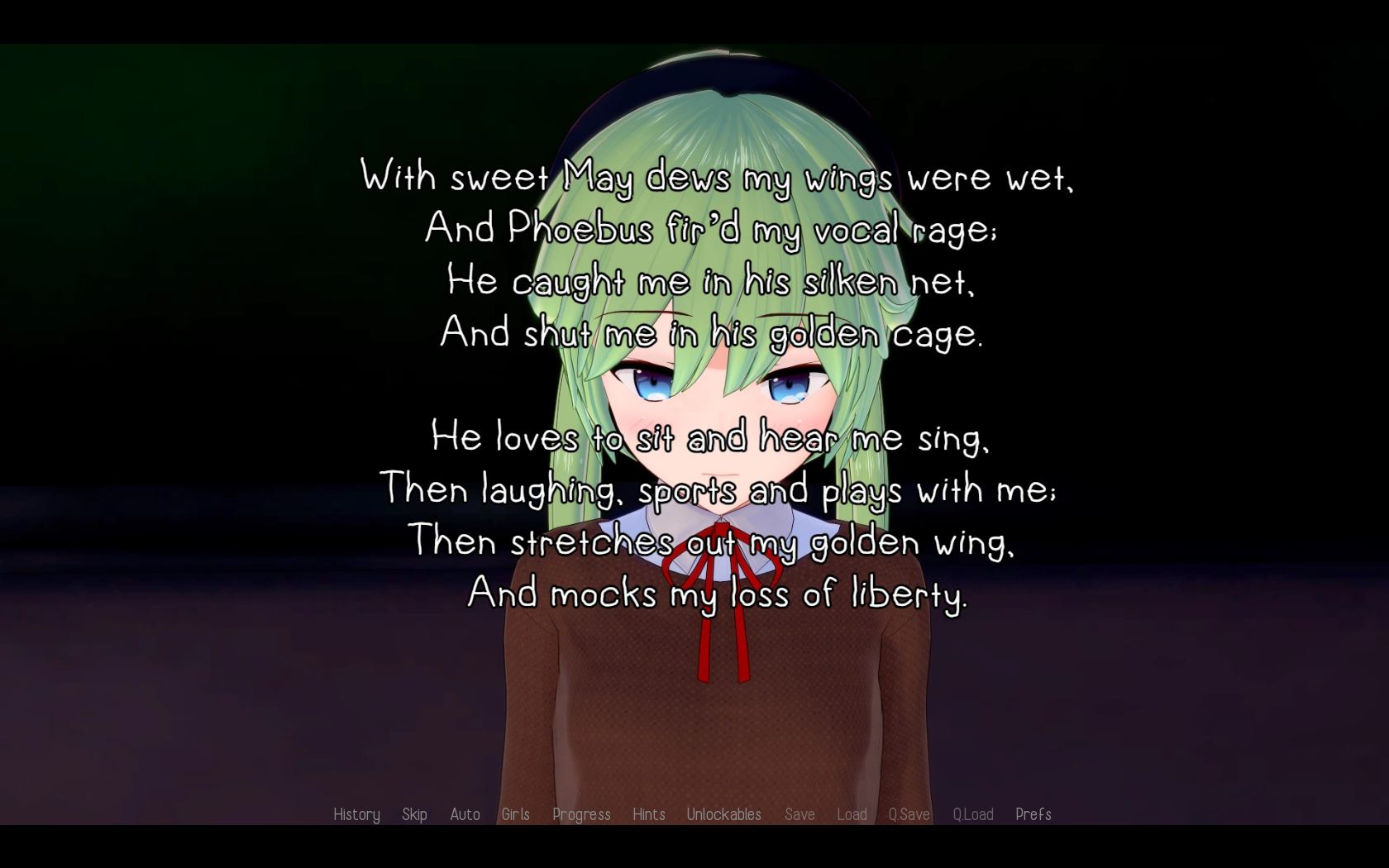
With sweet May dews my wings were wet,
And Phoebus fir'd my vocal rage;
He caught me in his silken net,
And shut me in his golden cage.He loves to sit and hear me sing,
Then, laughing, sports and plays with me;
Then stretches out my golden wing,
And mocks my loss of liberty.
This excerpt comes from "How sweet I roam'd from field to field" in Poetical Sketches of William Blake, Selebus's favorite poet. Blake's poems like "Infant Joy" and "Poison Tree" from Songs of Innocence and Experience are crucial motifs in understanding the contradictory tensions found in the game's exploration of love and sex. But the inclusion of this lesser-known poem in this specific scene surprised me: it's about the Ancient Greek god Apollo (Phoebus is another name for him) capturing the woman speaker for his own pleasures.
Its tone differs with how this scene will eventually end: Io escapes the classroom without saying a word, and Sensei chases her, wondering why he is even doing this before realizing he may need to be a temporary good Samaritan before doing anything sexual with her. This kind gesture is very out of place for a character like him, and I think it is tempting to view Sensei as not being inhuman enough to ignore Io's plights. Yet, if we read the full poem, it is Apollo who seduces the speaker with "lilies for my hair / And blushing roses for my brow; / He led me through his gardens fair, / Where all his golden pleasures grow." Does the incorporation of this poem in this moment suggest that Io is the speaker, Sensei the Phoebus in the poem, and "his gardens fair" the classroom of students whom Sensei is grooming?
This question vexed me. Io is my favorite character in the entire game, so I want the best for her. And it's not like I trust Sensei to begin with anyway ... but it's such a wholesome act that I can't help but start wondering if it's possible for the two to develop a platonic relationship. Maybe, this won't end up in abuse. Sensei won't be her Apollo, right? But I also had to take a step back and wonder if my interest in her as a player is secretly Apollonian too.
I don't really have a clear answer for this. Lessons in Love is still an ongoing story, and there will always be new scenes that change how I perceive past events. But I imagine the final answer is that Sensei and I share some degree of complicity. Accidental Apollos or not, I feel like we are in the end still guiding her to our "golden cage". She deserves her "liberty" -- I'm just unsure what the shape of it would look like.
My literary critic brain is also stimulated by the enigmatic "A Trip to Uzbekistan" event in Chapter 4. It begins like this:
I'm going to Uzbekistan today.
Not literally, of course. Walls.
I mean mentally. Just not entirely mentally because I have no clue what type of place Uzbekistan actually is or why I’d ever go there in the first place. I’m sure it’s fine.
But there’s this poem I read with Ami the other day — one that dragged on for far too long — about some guy who carved out an empire and fell for some girl or something. His name was Timur and he was lame.
But he had passion — something I lack. And that made me jealous of him despite all of the anger that was gradually building up over the course of an unnecessarily long poem.
So today, my goal is to be like him. My goal is to find passion for love or imperial expansion or whatever it is that gets me to feel like I’m living for something rather than just living.
But it has to be Uzbekistan because there is no purity here and, from what I’ve heard, that’s where it’s lost. Which also means it’s where it can be found.
The adventures of Steve continue alone.
Despite his coy phrasings and later characterization of Timur as "someone from a poem who'd probably become increasingly less relatable the more stuff you knew about him", Sensei is highly charged with the poetic language of Edgar Allan Poe's "Tamerlane" , so much so that a few stanzas bleed into a CG:

O, she was worthy of all love!
Love—as in infancy was mine—
Twas such as angel minds above
Might envy; her young heart the shrine
On which my every hope and thought
Were incense—then a goodly gift,
For they were childish and upright—
Pure—as her young example taught:
Why did I leave it, and, adrift,
Trust to the fire within, for light?
This image composition is utterly fascinating: the poem is sandwiched between the two characters, as if it is a literal embodiment of social distancing. Sensei internalizes the speaker's perspective and sees the girl he's carrying shopping bags for as a stand-in for the love interest Timur dropped to pursue political ambitions.
It was edifying for me to read the entire poem and see where that passage comes from -- near the end, actually. Poe's Timur chronicles how his heart has become an empty wilderness after achieving his hollow goals. The final stanzas read as the remaining regrets of a dying man: "How was it that ambition crept, / Unseen, amid the revels there, / Till growing bold, he laughed and leapt / In the tangles of Love's very hair?"
This gives me a tantalizing clue on how to read a slightly bewildering claim by Sensei later in the scene: he states that he's searching for a "happy ending" for Timur. Clearly, he sees the parallels and is on the verge of realizing that he might never reach happiness if he continues this path of self-destruction. In other words, Sensei is a self-aware Tamerlane. But it raises the following question: should the Timurs of our world deserve happiness, or should we simply abandon them to their excesses?
I wish I knew how to answer it. I know that I'm reading a grooming game, and I expect objectionable content at every corner. Yet, I feel surprised and hurt by how he objectifies the people he cares about into sex dolls he can dissociate with. We can see the glimmers of humanity in Poe's "Tamerlane" and Sensei, which is probably why the excerpt feels so moving -- Tamerlane realizes what he's lost, and Sensei doesn't know how to remove himself from his debilitating sex addiction, even if he recognizes that he's dragging everyone with him.
They are reprehensible figures, yes, but I don't believe we need to redeem them. The speaker of "Tamerlane" does not seek forgiveness: he begins his soliloquy by claiming the "KIND solace in a dying hour!" is "not (now) my theme". Instead, he wants to explain "the secret of a spirit / Bow'd from its wild pride into shame." He wants to clarify "amid the Jewels of my throne" that his "craving heart" desires "the lost flowers / And sunshine of my summer hours!" I read him (and Sensei for that matter) as wanting to be understood as people with human desires. The moralistic lessons we may gather to condemn these protagonists for the evils they've unleashed are superficial when we read closely their histories. They know they cannot apologize for their sins, but they do deserve a slight shedding of pathos.
This is, I think, the most provocative question posed by Lessons in Love's themes: is it possible to move on without diminishing or exacerbating the harm? We may crave punitive punishment or become too readily forgiving, but they are only for our satisfaction. More importantly, the spectacle of accurately measuring the degree of harm and charting out the timeline on how the abuser should work their way toward forgiveness do not construct a safe world for survivors. It becomes more difficult if we try to trace the beginnings of the violence too: the cycles of abuse must have started from somewhere, but how do we search for its genesis when everyone has their own reasons to speak half-truths or cannot recollect why they're there?
This is not to say we give up on correctly attributing the blame, but there's so much harm in the world that everyone feels the need to protect themselves from it first. And sometimes, that means enacting more violence upon others to rescue themselves. It's what generates the cyclical nature of these structural harms.
The reader is always reminded that "there is something buried underneath your feet." I don't think it's just a play on a fantastic short story; it suggests there's something disgusting and malicious lurking in the background that you the player don't know but other characters do. We see evidence of this in what the game calls "Happy Scenes", events that could be characterized as having heightened surreal imagery ala "denpa":
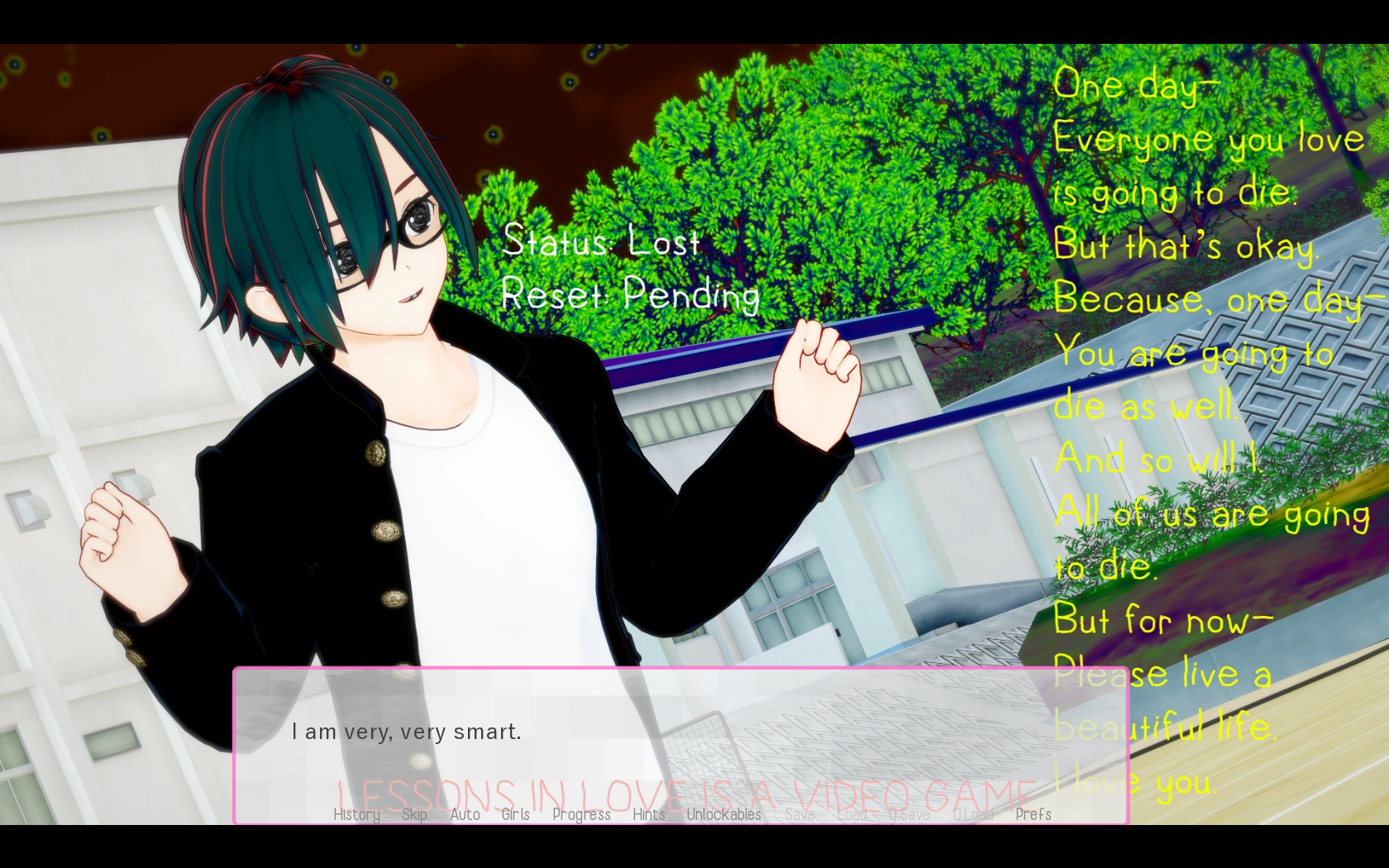
The above screenshot comes from a Chapter 1 Happy Scene titled "Everything is Connected". The palette is super saturated. Sensei is wandering in the soccer field and seems excited. His status text, hovering near him, says he's "lost". An original poem is on his right where a speaker tells the reader to remember that everyone around you will die and so will you, "But for now- / Please live a / beautiful life. / I love you." And at the very bottom, hidden behind the textbox, is red text reading "LESSONS IN LOVE IS A VIDEO GAME". This is somewhat typical of Chapter 1's Happy Scenes: the game indulges in nightmarish imagery very derived from Subarashiki Hibi. Symbols and text flood the screen, indicating to the player how little they know about the metaphysical world that ties things together. Food for thought for the people who like to chew on religious motifs and psychosexual imagery. While I was initially skeptical about the uncanny visual language of these scenes as a SubaHibi fan, the unease perpetuated by this known unknown makes one friend describe the mood of the game as something like a slasher film -- you know these silly characters are gonna get fucked the longer we let the drama play out. When the cast undertake more and more reckless actions that would lead to disastrous consequences, these symbols and motifs would resurface in different forms. They would start to take shape in my mind as something more concrete, visceral, and vital to understanding the backstories of these characters.
As the game goes on, the Happy Scenes and adjacent events become more blunt about depicting trauma. The metafiction and metaphysical worldbuilding are still there for any denpa fans, but I am more disturbed by how grounded these scenes will later be; I don't know how to respond to what are clearly coping mechanisms against something larger and scary.
Take the original poem in a Chapter 2 Happy Scene, "Good Boy": the speaker says that from today onwards, they're "going to be a good boy." They do what good boys are expected to do -- buckling their belts, tying both their shoes, shovelling the driveway, folding the laundry -- and then:
I'll take off my pants, stay quiet for you. I won't tell a soul. I promise it's true.
I'm such a good boy, so why can't I play? Why can't I have friends? I'll do what you say.
I'm such a good boy. Obedient too. So easy to touch, so easy to use.
So easy to break, yet you always play rough. I'm such a good boy. Can't that be enough?
I buckle my belt and tie both my shoes, cause that's what all the good boys do.
I put on my backpack and keep my mouth shut. Then saunter to school with a pain in my gut.
Today, I am going to be a good boy.
The repetitive sentences of good boys doing chores disarm me enough that I was taken aback by the implication of child abuse. And yet, I catch myself wanting to sing along with the nursery rhyme-like meter. Rhyming "rough" and "enough" in the same line is also so unnerving: while technically a perfect rhyme, I almost want to read it as a slant rhyme, making "enough" sound richly dissonant -- it is a word burdened with so much repressed emotions. And the refrain "what all the good boys do" underscores the speaker trying to downplay the terror of this situation, even when they admit they're "saunter[ing] to school with a pain in my gut". This is what all good boys must do according to the poem: be "so easy to touch, so easy to use."
"Good Boy" belongs to one of the many scenes that make me nauseous, despite my long experience with extreme content. It's not that they are gory or "fucked up", but because I've spent so much time reading the interior lives of these characters, I knew perfectly well the messy motivations that drove them into these horrific situations. Emotionally scarring is how I might put it: I would feel unwell realizing where the narrative direction is heading, the dread that this event will continue reverberating in the near future, and that any attempt to tone down the visceral content would lessen the impact of the game's themes. I frequently found myself taking breaks from the game, something I've never done before for any piece of media.
Likewise, I know several people who played the game with me around the same time needing to tap out from reading all the scenes. While we agree that the so-called Bad Uncle path (agree to have sex with Ami) is vital, there are a few choices in Chapter 4 that are the stuff of nightmares. Even the people who worked on Japanese visual novels that folks might consider extreme have stared at one choice in particular and couldn't dare mousing over the choice that unlocks more content. I'm one of the few people who remain on this path, but I also won't belittle anyone who need to get out or even not want to engage with the work after reading this article -- Lessons in Love is a very demanding game, and I'm not someone who will demean people for not reading it.
That said, even the people who couldn't stomach the "optional" scenes agree with me that the extreme content is perhaps one of the game's defining features. These scenes help develop the language the game uses to articulate specific aspects of trauma and sex that are just hard to talk about in plain language. The stigmas of abuse, trauma, and arousal make it difficult to have an open conversation without someone shutting it down. Thus, the cryptic remarks about the world and past history, uncomfortable or even downright traumatizing scenes, and the few snippets of narration where the game expresses its distress against Sensei (and players) not getting the message and telling them to just quit -- they are members of a growing arsenal of provocations to get the player to reflect on the conditions of living with trauma and abuse.
This also complements the general antipathy toward players. Scattered throughout the game are escape room-adjacent puzzles that require you to input numbers or keywords that appear in earlier scenes. Anyone who's played the game will fondly remember Chapter 2's "A Life of Prizes", an event inspired by a real Japanese TV game show where Sensei needs to fill in sweepstakes answering obscure questions to get keys -- I consider this to be the second hardest puzzle in the entire game. I can easily picture the TTS narrator taunting me by chanting repeatedly one of its many recorded lines, "Are you having fun? Are you having a good time? Tell me you see me. Tell me you see me. Tell me you see me. I am so happy to be with you right now."
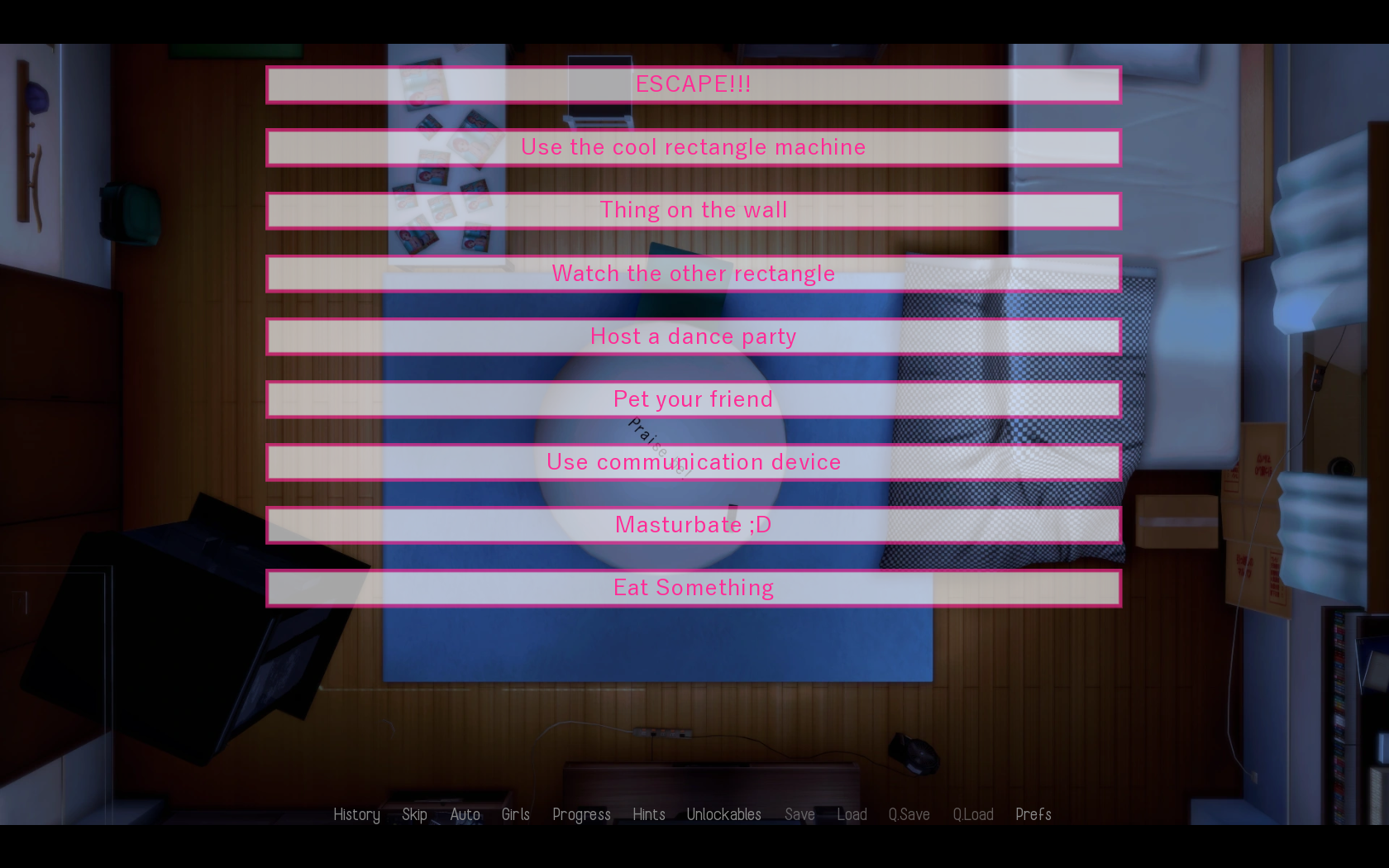
At the very least, one could pet Manny the Friendly Maggot and ask them for advice. Unfortunately, Manny is stuck in an earlier, easier puzzle, to which Sensei complains:
Sensei: I don't even know why puzzles have to exist in this stupid game. I should be able to experience the story however I want because I am important and special and art is only good when I say so.
[...]
Sensei: But anyway, I guess I'll get back to trying to remember stuff or...waiting for someone to make a me a mod since visual novels are too hard for me and I require outside assistance.
Manny the Friendly Maggot: Why are you even playing, then?
Sensei: Because I've jerked off normally too many times and need a challenge in order to cum at this point.
Sensei: Only a slight challenge, though. If it's any more challenging than I want it to be, it's stupid. But I'm going to keep playing anyway because that is a decision that makes sense.
Manny the Friendly Maggot: Well, I hope you have fun!
Manny the Friendly Maggot: I'll be here if you want to repeat this same exact conversation again. It might help keep you entertained if you start going crazy!
Sensei: Thanks, Manny! I'll see you later.
I will admit that I've reread this conversation many, many times in my fruitless quest for clues. I can't be the kind of player the game is criticizing, right? But I felt its ire. Continuing to play did feel like a decision that made less and less sense.
Yet, I found its antagonism welcoming. Don't get me wrong, Lessons in Love is proud to be a niche, self-selecting game, something that many people might justifiably be at odds with. But the friction the game imposes on the player is like an act of recognition: if you really want to see more of what the game is about, you have to solve these outrageous puzzles; otherwise, it thinks you're here just for the porn and that's it. It obviously wants to test your willpower, but I also read it as the game kinda trusting me as a player who can figure shit out. Rather than letting me mindlessly consume content like a bot scrapping the web, I need to put in the effort and verify that I'm actually human in the most convoluted CAPTCHA test ever devised. These reading comprehension gotchas force me to carefully reread scenes that I may have skimmed a few days ago, and I do appreciate how absurdly painful it can be.
And honestly, if it isn't this hostile, I wonder if the more upsetting content gated by these events will feel cheap. Because I actually spent hours getting the game to let me in, any distressing scene will feel earned -- I signed the terms and conditions by solving the ridiculous puzzles and walked straight into said events. I cannot imagine a version of Lessons in Love without this tug of war relationship leading me on. Indeed, it makes me constantly ask myself what's the point, and I think that's part of the intent: it wants to make me interrogate why I need to uncover more of the narrative and why I'm here in the first place.
That's why I feel obligated to analyze the literary qualities of the game and think about their affects on me. I want to understand scenes like Chapter 4's "Trans-Pacific Sadness Symposium II: SISTER SOFTSKIN" where sections of the narration read like this:
She knew what they were saying because she wasn’t a fucking moron like you. She’d cleaned blood off her roommate, Occam’s, razor before and wasn’t perplexed by neglected complexities.
She was part of the codex — an abject auspex practicing breakneck safe sex, slipping objects in the convex annexes of each attic in the narthex.
She didn’t care about the effects. She paid no mind to things like that as she was too busy swimming in doubt and cum and more doubt and more cum and you were-
What were you doing?
I watched you last night. And I didn't quite understand.
Please write your actions down on a piece of construction paper and slip it into my PO
xbox so I can come closer to replicating you for my next art installment.
I can't really make sense of any of these lines, but I do enjoy reading aloud the "abject auspex" line -- it's got the rhythm of a tongue-twister, so the sonic qualities of the sentence give that line its staying power. The scene also gestures at something deeper going on with the setting. But more often than not, I find myself preferring to linger on the sentence level and preach about the aural aesthetics of the writing. It's just pleasing to meditate on eclectic phrases like "breakneck safe sex". Writing like this is why a friend once described the game as "writer's catnip": there is so much joy and wit in the writing that it has inspired so many writers and poets to return to or elevate their trade.
At the same, I think it's also easy to lose sight of why this game has so much emotional resonance for me. I opine in a few theorycrafting discussions like any dutiful fan, but I do feel that I'm more drawn to deep dives on the game's themes. In particular, I enjoy reading how people connect the setting details to how the narrative unpacks trauma, gender, and relationships. I mull over these readings because they give me more insights into the game's overall message.
I similarly exert my analytical energies to gauge the thematic stakes of the game. How do I view the game's lampooning of the sponsored content deluge on YouTube? I package it as part of the game's countercultural and punk attitude. Why does Ayane Amamiya listen to so much "Despacito"? Because it's a banger song. Not everything I couch as analysis is future-proof -- it is an after all ongoing game, and Selebus can switch his mind on something -- but this creative reading is what makes the game so personal to me.
I have a hard time imagining a happy ending for Sensei, but because the game wants me to move on without apologizing for his actions, I need to work my brains out. I don't want to rely too much on extrapolation, but I do feel like answering this call requires a degree of poetic license. Hundreds of hours in, I don't know what a solution might even look like. Nevertheless, I have to try because even the most incorrigible survivors deserve a way out of the cycles of abuse. Happiness should not be exclusive to people who have never suffered trauma as the status quo implies. I have to imagine something that's unimaginable by today's societal standards, a world where survivors can actually live happily. That's the message that I was able to interpret from the game, and it's a tall order.
But it's a message that resonates with me as both a player and a creative. It speaks to me the same way I might visit the bedroom of my childhood home: I open the windows to clear the dust out and let sunlight in; the memories pouring in evoke the fantasies and dread I used to have growing up but repressed to conform for the sake of a working adult life; and I feel compelled to relive my childhood ideals, even if I feel hesitant and scared about being as vulnerable as my younger self. Refreshing my mental model of myself made me realize that I used to be more vocal about injustices, more assured about how I wrote lyrically, and more utopian about the future. My lack of imagination (exacerbated by the shame I feel about my own writing, the violence inflicted on my body and mental health, and my counterproductive, pessimistic outlook on the world) impedes me from doing the work I love the most: highlighting the personally rich works in my life and wanting others to feel something similar.
There's something to be said about how friends and acquaintances reading the game talk about how they're excited to return to the creative arts -- or in my case, learning how to compose poetry. I read poetry on and off, but Lessons in Love sparks my interest so much that I'm now thinking about meter and alliteration in my own prose. It has also given me permission to enjoy the writing process and let my words be as fun to read as it is to write.
And I have friends who yap like they've never yapped before because they were able to connect with themes in ways they were never able to in other works including subculture media. The tears we shed are not for mirages but for fiction tapping on something real that is hard to publicize. My heart feels warm seeing people just find ways to open up because of this game.
So while I agree with my friends showering superlatives like "this is the modern Ulysses" or "the greatest postmodernist literature of our time", I want to stress that it's an inspiring game for people like me who hyperfixate on the connections between art and trauma. I have to dig into my own memories and anxieties in order to craft an adequate response to the game's challenges. I have to imagine a happy story for Sensei not because I believe he will be a good guy who will learn from his mistakes but because the act of imagining a beautiful end for him is a synonym for the belief that happiness actually exists. It is not a myth we tell ourselves to stop our souls from rotting, but it is a leap of faith. We must enact happiness into existence.
This is why I want to financially support the game, to send some spare change to the charity drive after this article is published, and to see where the game takes us next. The message I've gleaned is something I truly believe in not just as a fan but as a person. I want to see the game absorb all the nuances that complicate its usual rhetoric on achieving happiness because I believe the game can handle any opposition. It is impossible to overstate how much I agree with its ambitions as a work about building a safe world for survivors to live in. I really want to believe those neglected by our current world can all be happy.
Nodoka Nagasawa is the last person I want to identify with, but she and I share similar views on fiction. An author with a cult following, she admits in Chapter 2's "Coloring Book" the value of writing literature is not that great. Instead, she says,
Nodoka: Okay, so maybe I am a genius. But anyone can be a genius if they spend their entire life just...living other lives via literature.
Nodoka: I said before that I’m not an actor, but one of the things I enjoy most of all is imagining how I would feel as someone else...Someone who isn't real.
Nodoka: Or what I would do in their shoes, if only I could fit into them.
She seems to distinguish enjoying literature for its own sake from the usual humanities mantra about how reading literature teaches you to form empathetic connections. It's simply a piece of entertainment to her.
Nodoka continues:
Nodoka: But the second I close the book, I’m just Nodoka again.
Nodoka: And everything turns gray.
Nodoka: And I have to go out and find new colors to fill everything back in.
Nodoka: Life would have been easier if I wasn’t printed as a picture book.
This is a sentiment I relate to. As someone who's been writing about subculture media for more than a decade, I am always yearning for new colors to add to my grayscale life.
It doesn't matter if my Steam and Kindle libraries are full of untouched titles. The consumerist neurons in my brain demand more: I think thoughts like "will this hardcore puzzle game go on sale in the Lunar New Year" and "when will this 90s fantasy light novel series go on sale already?". And when I finally get to it, I get disappointed by how derivative it all is.
When I do find something that excites my senses and let me see the world in technicolor again, I feel anxious about losing this newfound vibrancy. If I go through a work in a matter of hours, I will see the colors drain and seep away once more.
I think Nodoka puts it best when she describes why people like us have a love-hate relationship with fiction:
Nodoka: The main reason so many people fall in love with fiction is because they’re searching for something they can’t obtain on their own.
Nodoka: But there are also people who fall in love with it simply because there isn’t anything else to do.
Nodoka: People who get so bored of not being able to feel anything that they allow themselves to fall into those who can.
Nodoka: I kind of hate reading, actually.
Nodoka: It’s time consuming...you can’t do it in the dark...and the memories you get out of it can barely be called memories at all since they aren’t your own.
Nodoka: But the things I love about it always manage to outweigh those somehow.
Nodoka: Even when I wish they wouldn’t.
This brief monologue about boredom and false memories makes my heart beat. Even now, in my thirties, I don't know if how I feel is appropriate.
Fiction provides enough cues for me to understand that, yes, this is a scene about grief. In some ways, I wonder if I'm a bit broken in the head. You don't write years of criticism on subculture media without thinking something is up. I can only wallow on why I need fiction to live, to pretend that I'm even human.
But Sensei, in spite of his emotional immaturity and trauma, responds to Nodoka (and me) in a surprising manner:
Sensei: You don’t sound like a picture book at all, Nodoka.
Nodoka: Huh?
Sensei: You’re more like a...and forgive me in advance if this sounds childish-
Sensei: But you’re more like a coloring book.
Sensei: A really advanced one with a lot of difficult drawings that...requires special attention and weird colors like chartreuse and mauve.
Sensei: And you’re just waiting to be filled in.
Nodoka: ...
Nodoka: Oh...
Nodoka: It’s back.
Sensei: Hm? What is?
Nodoka: The color.
Nodoka: It’s been gone for days.
Sensei: ...
Nodoka: And there’s no chartreuse or mauve anywhere to be found...
Nodoka: Looks like you were wrong, Sensei.
Sensei: You just haven’t gotten to the page with all of the weird colors yet. You’re only in the beginning of the book.
There are many moments in the early parts of Lessons in Love that one realizes they're actually in head over heels for the game, but I remember this scene the most for its resolution.
I may not see eye to eye with Nodoka in a lot of things, including when she admits in Chapter 4's "Peregrine Falcon" her distaste for poetry because "they're too easy to understand" and she "prefer[s] the work associated with deciphering a good novel or short story instead". But the vulnerability she exposes to Sensei is one I know all too well, and to hear Sensei adequately respond to her needs gives me hope that I will find mauve and chartreuse someday. Even if they are emanating from a grooming game, these weird colors will make the world just a bit more liveable.
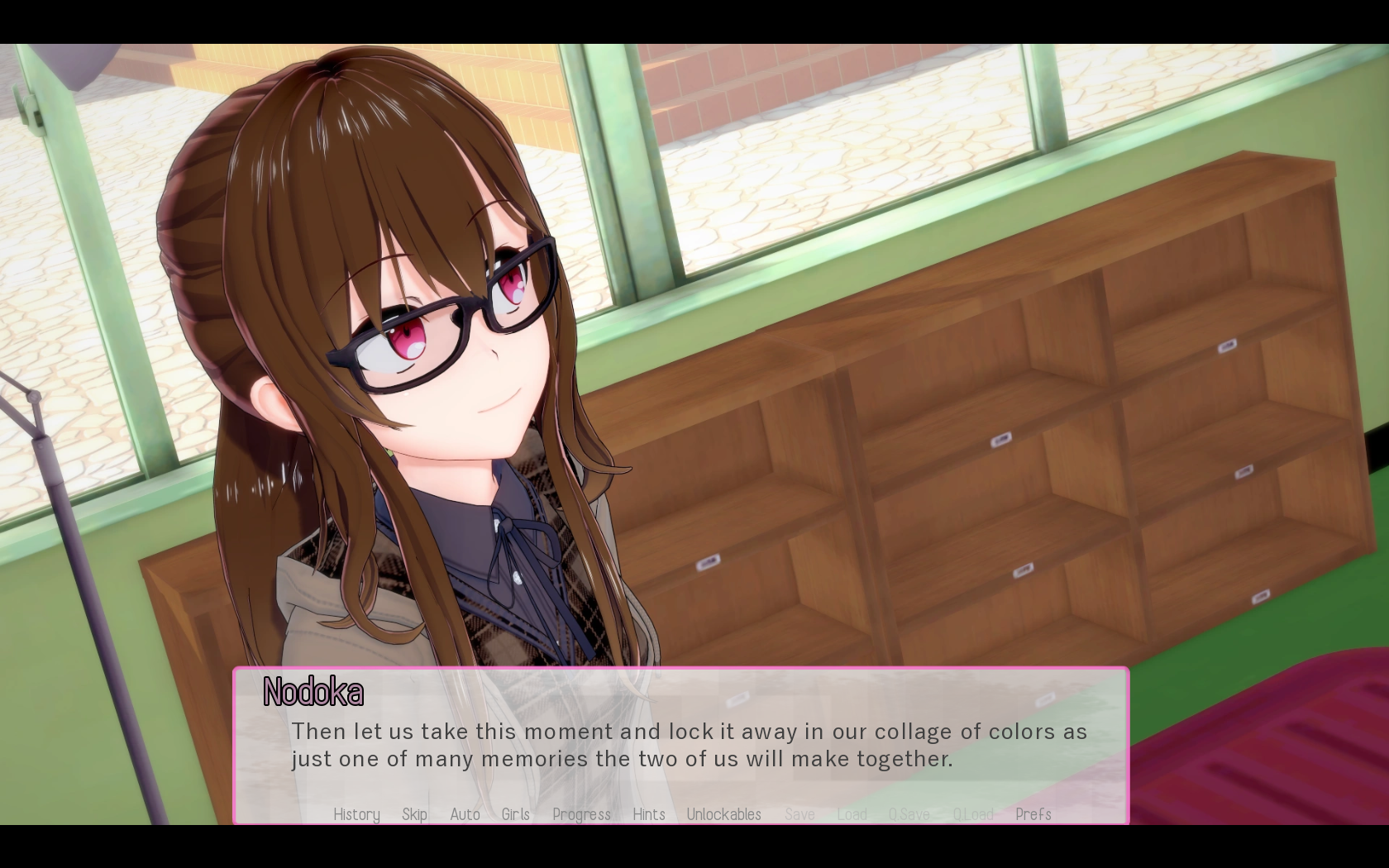
It doesn't matter if you don't get it after reading this essay. There are many valid reasons to be put off, but I want to say that the game exists like the many poems we come across and ignore every day. There may be something in the sea of content that arrests your attention for reasons difficult to explicate. When you finally read it, it etches in a new kind of color inside your book, and you feel a conviction to struggle and explain why this "weird color" matters -- reasons that may not align with what the author intended but are in perfect harmony with what you personally valorize.
I paced around the room, pondered about how I should structure my ruminations, and opened up a playlist to freewrite this essay not just because it's a visual novel worth knowing about -- it's because I treasure it. If I write essayistic criticism that lets me peer deeper into the hues of these new colors, I will be closer to filling in my own coloring book.
So whether you're reading Lessons in Love or not, I hope you will find something that motivates you to connect the dots and uncover something profound about yourself and others. It doesn't have to feature extreme content, plot twists, or prose poetry -- just something that echoes in your soul. As long as you latch onto it, I am sure you'll discover a few things about what makes you happy.🌻
Thanks to quincognito for additional feedback and Len for corrections.